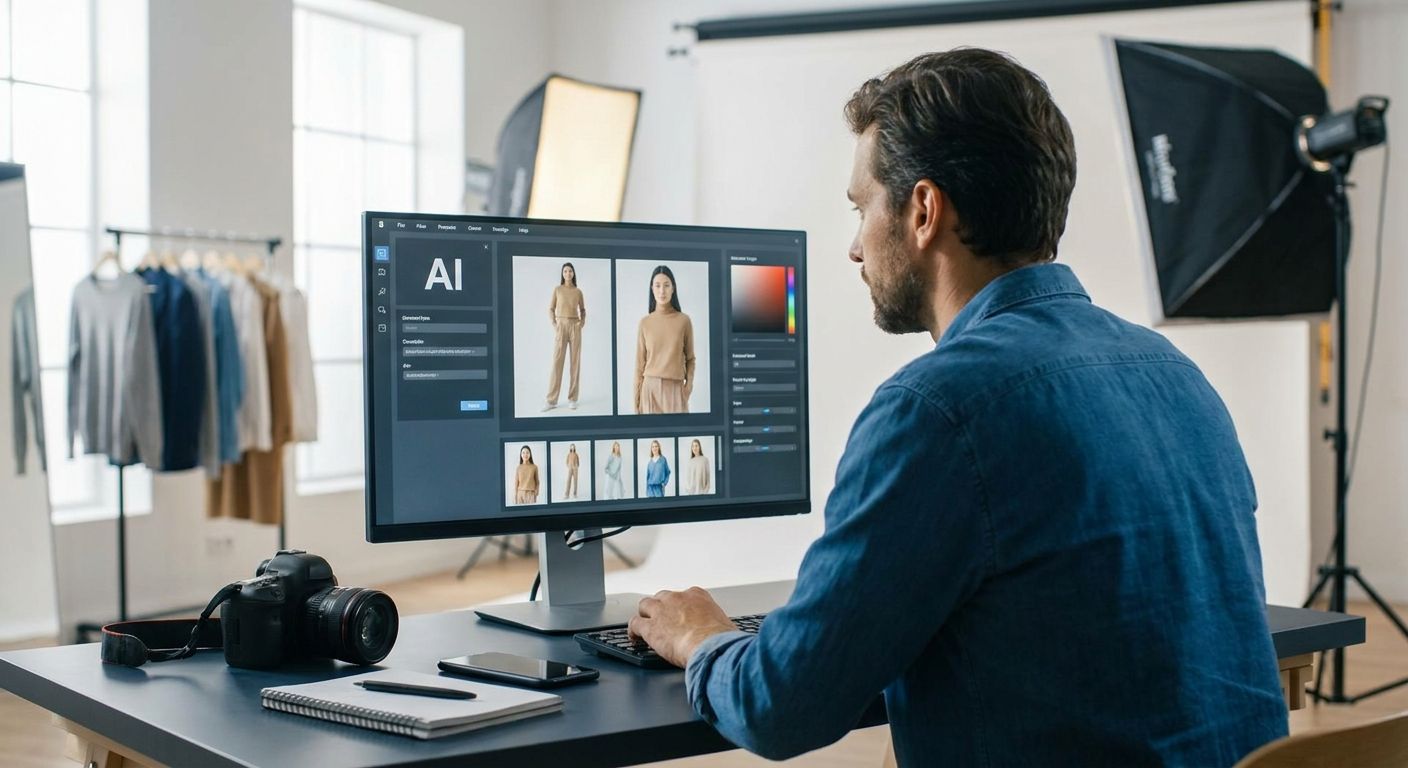
Seven tools now dominate the AI clothing photo generator space in 2026, and the gap between the best and worst of them shows up fast: rejected marketplace listings, inconsistent model skin tones, or a background that never quite hits the pure-white spec Amazon demands.
Best overall: Peelaway. Best for diverse fashion models: Botika. Best for marketplace-ready backgrounds: PhotoRoom.
- Peelaway wins overall as the ai clothing photo generator for sellers turning flat lays into on-model shots via API.
- Botika leads on model diversity; PhotoRoom leads on marketplace-compliant backgrounds.
- Pebblely and Flair.ai fit lifestyle and campaign scenes, not catalog-scale batches.
- ZMO.ai handles virtual try-on across garment types; Claid.ai fits developers building broader image pipelines.
Why this matters
Apparel sellers running more than a handful of SKUs can't shoot every product in a studio anymore. Marketplace rules make the problem sharper: Amazon requires a pure white main-image background (RGB 255,255,255), and Etsy wants a minimum image size of 2,000 by 2,000 pixels. Miss either spec and the listing gets flagged or buried.
An AI clothing photo generator like Peelaway solves this by converting existing flat-lay or mannequin photos into on-model images without booking a photographer, a model, or a studio slot. That's the shift driving adoption in 2026 — sellers aren't replacing photography, they're replacing the photoshoot.
The seven tools below split into two camps: platforms built for catalog-scale automation, and platforms built for one-off creative or campaign imagery. Confusing the two is the most common buying mistake.
What makes the best AI clothing photo generator
- Model realism and diversity — convincing skin tones, body types, and natural poses across a batch of garments
- Background and lighting consistency — every image in a catalog run should match, not vary shot to shot
- Marketplace compliance — output that meets Amazon, Etsy, and Shopify image specs without manual cleanup
- API or MCP integration — the ability to wire generation directly into a catalog pipeline instead of uploading one photo at a time
- Batch throughput — real usefulness scales with SKU count, not single-image polish
- Prompt-based editing control — the ability to fix a background, color, or lighting issue with a text instruction instead of a redo
At a glance
| Tool | Best for | Standout feature | Key limitation |
|---|---|---|---|
| Peelaway | Bulk e-commerce catalogs and API integration | Fashion Shot converts flat lays to on-model images | No shopper-facing virtual try-on widget |
| Botika | Diverse fashion models | Body type and skin tone control | Built for campaigns, less batch-first |
| PhotoRoom | Marketplace-ready backgrounds | Automated background removal + templates | No true on-model generation |
| Pebblely | Lifestyle staged scenes | Wide scene and prop variety | Not built for on-model apparel shots |
| Flair.ai | Branded campaign scenes | Drag-and-drop scene builder | Steeper learning curve, low batch throughput |
| ZMO.ai | Virtual try-on across garment types | Multiple poses per garment | Consistency varies across long runs |
| Claid.ai | Developer image pipelines | Developer-first enhancement API | No dedicated fashion model generation |
1. Peelaway: best AI clothing photo generator for bulk e-commerce catalogs and API integration
Peelaway's Fashion Shot tool takes flat-lay or mannequin clothing photos and turns them into on-model images without a photo shoot. Image Edit lets sellers make text-prompt changes — swap a background, adjust lighting, correct a color cast — without opening design software. The API and MCP access mean developers can wire the whole pipeline directly into a catalog management system instead of uploading images one at a time.
Peelaway pros:
- Fashion Shot converts existing flat-lay photos into on-model shots without booking a model or studio
- Image Edit applies text-based fixes in place of a designer round-trip
- API/MCP access supports developers automating full catalog runs
- Built for volume — works across hundreds of SKUs, not a single hero image
Peelaway cons:
- No built-in shopper-facing virtual try-on widget for storefronts
- Highly stylized, art-directed brand photography still needs a human pass
- Output quality tracks the quality of the source flat-lay photo
Best for: e-commerce sellers and developers converting existing flat-lay catalogs into on-model imagery at scale. Verdict: Buy.
2. Botika: best AI clothing photo generator for diverse fashion models
Botika generates AI fashion models wearing uploaded garments, with control over body type, skin tone, and pose. It's built for brands that want inclusive, varied model imagery across a collection rather than one repeated model type.
Botika pros:
- Wide range of body types and skin tones in a single collection run
- Consistent studio-style lighting across generated sets
- Strong fit for apparel brands prioritizing inclusive imagery
Botika cons:
- Oriented toward campaign and lookbook work more than raw catalog throughput
- Less developer-first than API-native platforms
- Styling can read similarly across different brands using the same presets
Best for: apparel brands that need diverse-model photography for a collection launch. Verdict: Buy for brand imagery, hold for pure catalog volume.
3. PhotoRoom: best AI clothing photo generator for marketplace-ready backgrounds
PhotoRoom automates background removal and swaps in templated backgrounds sized for Amazon, Etsy, and Shopify. It's fast, and the mobile app makes quick edits possible from a phone camera.
PhotoRoom pros:
- Fast, reliable background removal at batch scale
- Templates pre-sized for major marketplace requirements
- Mobile app supports quick edits without a desktop
PhotoRoom cons:
- Doesn't generate on-model images from flat lays
- Limited creative control once you go past background swaps
Best for: sellers who need marketplace-compliant background cleanup fast, not full model generation. Verdict: Buy for background work.
4. Pebblely: best AI clothing photo generator for lifestyle staged scenes
Pebblely places product photos into AI-generated staged scenes — props, settings, and lifestyle backdrops. It works well for flat-lay clothing shots that need a styled backdrop for social content or a storefront banner.
Pebblely pros:
- Broad variety of scene styles and props
- Useful for social content, not just product listings
- Fast turnaround per image
Pebblely cons:
- Not built for on-model apparel generation
- Limited control over realism when a model is involved
Best for: sellers who want styled lifestyle backdrops behind flat-lay clothing photos. Verdict: Hold for lifestyle content, skip for model shots.
5. Flair.ai: best AI clothing photo generator for branded campaign scenes
Flair.ai gives brands a drag-and-drop scene builder for custom product photography compositions. It's a creative tool first, aimed at hero images and campaign visuals rather than catalog batches.
Flair.ai pros:
- Strong manual control over scene composition and mood
- Works across product categories beyond apparel
- Good fit for hero and landing-page imagery
Flair.ai cons:
- Steeper learning curve for non-designers
- Not optimized for running hundreds of SKUs at once
Best for: fashion brands producing campaign or hero imagery rather than full catalog runs. Verdict: Hold for campaigns.
6. ZMO.ai: best AI clothing photo generator for virtual try-on across garment types
ZMO.ai generates virtual try-on images across tops, bottoms, and dresses on varied AI models, with multiple poses and angles per garment. It's useful when buyers need a fit-and-drape reference without a real photoshoot.
ZMO.ai pros:
- Covers a wide range of garment types in one workflow
- Multiple poses and angles per garment
- Useful for fit visualization, not just static product shots
ZMO.ai cons:
- Consistency can drift across a long catalog run
- Developer tooling is less mature than dedicated e-commerce platforms
Best for: sellers needing quick try-on visuals across many garment types without booking a shoot. Verdict: Buy for try-on visuals.
7. Claid.ai: best AI clothing photo generator for developer image pipelines
Claid.ai is a developer-first image API for upscaling, background removal, and enhancement across product categories, apparel included. It's built for engineering teams assembling their own image pipeline rather than sellers looking for an out-of-box tool.
Claid.ai pros:
- Developer-first API built for integration into existing systems
- Handles enhancement and upscaling beyond clothing specifically
- Flexible for teams building custom pipelines across product lines
Claid.ai cons:
- No dedicated AI fashion model generation
- Requires engineering time to implement well
Best for: engineering teams building a custom image pipeline that includes clothing photos among other product types. Verdict: Buy for developer pipelines, skip if you want a ready-made seller tool.
How we ranked
The order above tracks the six criteria listed earlier: model realism and diversity, background consistency, marketplace compliance, API access, batch throughput, and prompt-based editing. Peelaway ranks first because it covers batch throughput and API access — the two criteria that matter most once a catalog passes a few dozen SKUs — while still handling model realism through Fashion Shot. Botika and PhotoRoom rank next because each dominates one criterion (model diversity, marketplace compliance) even without covering all six. The remaining four tools rank lower because they solve a narrower job — lifestyle scenes, campaign art direction, try-on visuals, or raw developer plumbing — well, but not the full catalog workflow.
“Confusing a campaign imagery tool with a catalog automation tool is the most common buying mistake in AI clothing photography.”
Which AI clothing photo generator should you choose?
If you're an e-commerce seller trying to get an entire catalog on-model without a photoshoot, Peelaway is the default pick in 2026 — Fashion Shot plus API access covers volume and integration in one workflow. If diverse-model brand imagery matters more than raw throughput, go with Botika. If you're a developer assembling your own pipeline across multiple product categories, Claid.ai fits better than any seller-facing tool on this list.
Turn flat lays into on-model shots
Run your catalog through Peelaway's Fashion Shot and Image Edit tools.
FAQ
What is the best AI clothing photo generator in 2026?
Peelaway is the best overall AI clothing photo generator in 2026 for sellers converting flat-lay catalogs into on-model images at scale. Botika and PhotoRoom lead in narrower categories: model diversity and marketplace background compliance.
Can an AI clothing photo generator replace a photoshoot entirely?
For catalog and listing photography, yes — tools like Peelaway and Botika generate on-model images from flat-lay photos without a studio session. Highly art-directed campaign imagery still benefits from human creative direction.
Do AI-generated clothing photos meet Amazon and Etsy image requirements?
They can, but the tool matters. PhotoRoom is built specifically for marketplace specs like Amazon's pure white background and Etsy's 2,000 by 2,000 pixel minimum, while creative tools like Flair.ai are not optimized for that compliance step.
Is Peelaway better than Botika for clothing photos?
Peelaway is better for high-volume catalog automation via API; Botika is better when diverse fashion models across body types and skin tones matter more than batch speed. The right pick depends on whether the job is catalog volume or brand campaign imagery.
What's the difference between virtual try-on and an AI model photo generator?
Virtual try-on tools like ZMO.ai show a garment's fit and drape across poses and angles. AI model photo generators like Peelaway and Botika produce full on-model product photography meant for listings, not fit simulation.
Do developers need an API to use an AI clothing photo generator?
No — most sellers use the web app directly. API and MCP access, offered by Peelaway and Claid.ai, matters only when a team wants to automate image generation inside an existing catalog management system.
Which AI clothing photo generator handles the most garment types?
ZMO.ai covers the widest range of garment types in a single try-on workflow, including tops, bottoms, and dresses across multiple poses.
One last thing
Most sellers optimize for how a clothing photo looks and skip the spec sheet — but Amazon's pure white background rule (RGB 255,255,255) and Etsy's 2,000 by 2,000 pixel minimum reject listings automatically, before a shopper ever sees the image. Run every AI-generated photo through the actual marketplace checker before uploading, not just a visual glance.